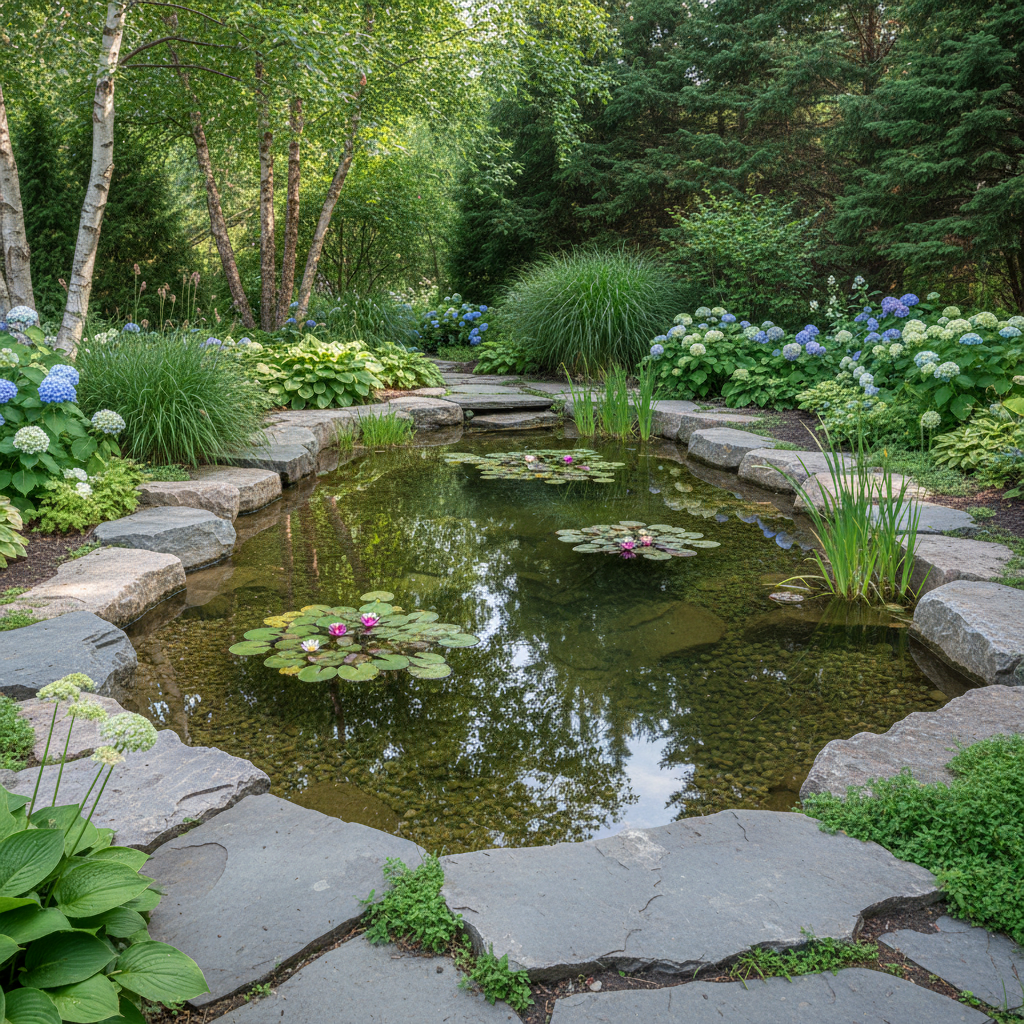
How Much Does Each Type of Water Feature Cost?
All prices below reflect 2026 installation costs in the Collingwood, Blue Mountain, and Georgian Bay market, including materials, excavation, pump and filtration systems, and labour. See our full water features service for the breadth of what we design and build.
Ecosystem Koi Pond
- Installed cost: $5,100 to $15,900
- Includes excavation, EPDM rubber liner, biological filtration system, circulation pump, aquatic plantings, and natural stone edging
- Size is the primary cost driver: a 6x8 ft pond with a small cascade sits at the lower end; a 10x15 ft pond with a stream feature reaches the upper end
- Ontario depth requirement: minimum 2 feet for fish survival in winter - 4 to 6 feet is strongly recommended for reliable koi overwintering in the Georgian Bay corridor
- A shallow koi pond is a liability: ice forms 12 to 18 inches thick in severe Georgian Bay winters
Planning for a koi pond means budgeting for more than the installation. Annual maintenance ($500 to $1,500), periodic fish restocking if losses occur, and winterization all factor into the true lifecycle cost. We design every pond with its maintenance schedule built in from the first conversation.
Pondless Waterfall
- Installed cost: $5,000 to $12,000
- Water flows over a cascade of natural stone and disappears into a hidden underground reservoir - no standing water, no pond maintenance
- The underground basin and circulation pump are the primary costs; stone selection and cascade height affect the upper range
- No standing water means no fish to care for and significantly lower maintenance
- Popular with homeowners who want the sound of moving water without pond upkeep or safety concerns around standing water
Bubbling Basalt Column or Core-Drilled Stone
- Installed cost: $2,000 to $5,000
- A drilled stone - basalt column, granite boulder, or fieldstone - with water bubbling up from the centre and flowing over the surface into a hidden catch basin
- The simplest water feature to install and the lowest-maintenance option in the long run
- Spring startup and fall shutdown take under an hour each year
- A strong entry point for homeowners exploring water features for the first time
Formal Wall Spillway (Sheer Descent)
- Installed cost: $3,000 to $8,000
- Water flows in a smooth, even sheet from a wall-mounted blade into a catch basin or pool below
- Clean, architectural aesthetic that pairs well with contemporary hardscaping and outdoor kitchen designs
- The wall structure and plumbing integration are the primary cost drivers
- Must be designed for freeze-thaw with a fully drainable system for winter shutdown
Water Garden (Aquatic Plant Focus)
- Installed cost: $4,000 to $12,000
- A shallow pond designed primarily for aquatic plants: water lilies, native iris, pickerelweed, marsh marigold, and bog species
- Lower maintenance than a koi pond because the biological load from fish is absent
- Depth can be shallower (18 to 24 inches) since fish overwintering is not a concern
- Native Ontario aquatic plants overwinter reliably at 2+ feet of depth; tropical aquatics must be treated as annuals
Naturalized Stream Feature
- Installed cost: $6,000 to $15,000+
- A flowing stream winding through the landscape, connecting an elevated source to a lower collection point
- Natural stone, gravel beds, and marginal plantings create a naturalistic appearance that blends into Georgian Bay-area properties
- Length and grade change are the primary cost drivers
- Often combined with a pondless terminus or an ecosystem pond at the base
Reflecting Pool
- Installed cost: $5,000 to $10,000
- A still, shallow basin designed for visual reflection rather than biological activity or movement
- Geometric or natural-edge design; minimal filtration needed
- Frost-heave-resistant basin construction is critical in Ontario's climate - rigid basins must be engineered for seasonal freeze-thaw expansion
- Drains completely for winter; spring startup is simple
Ontario-Specific Considerations: Designing Water Features for Our Winters
This is the section that national cost guides miss entirely. What works in a Vancouver or California garden does not work in the Georgian Bay corridor. If your water feature provider does not address the following points specifically, they are designing for the wrong climate.
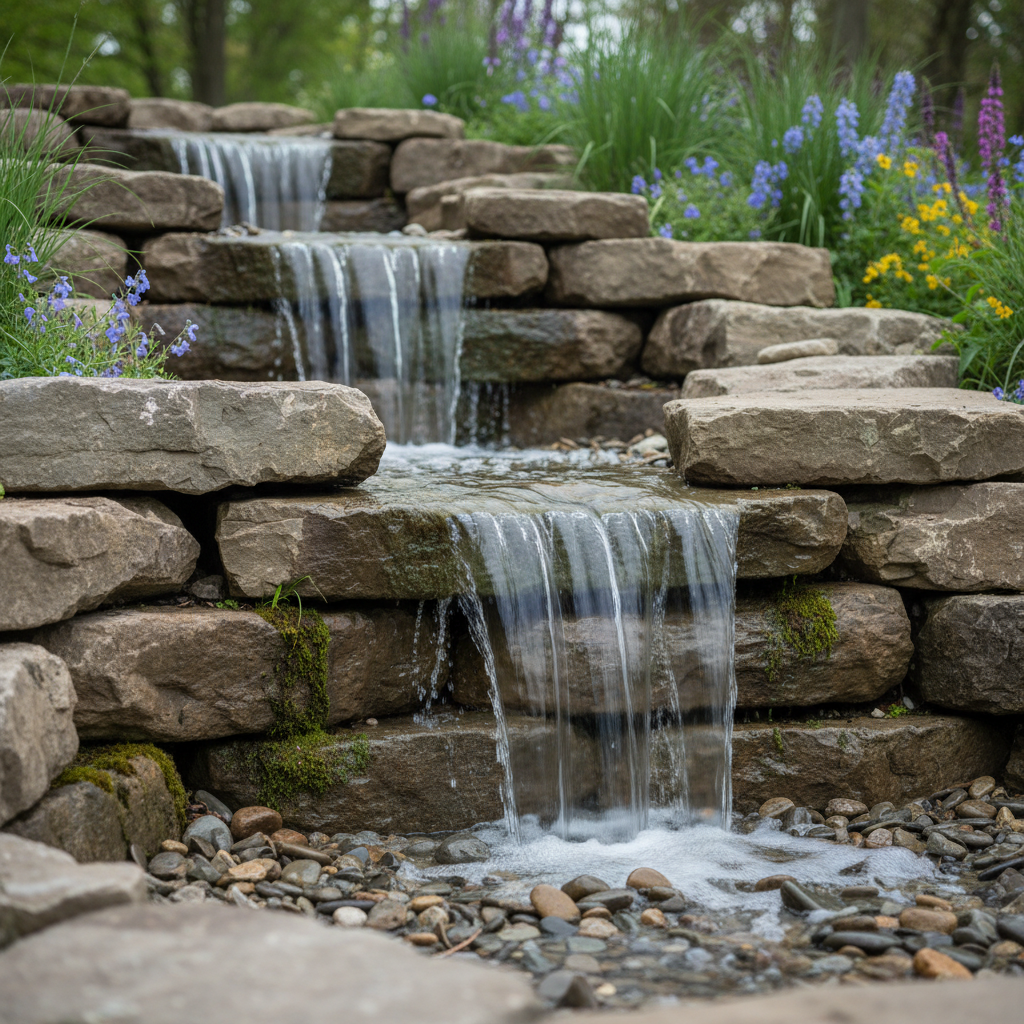
- Pond depth for fish survival: In Ontario, koi and goldfish need a minimum pond depth of 2 feet to survive winter - but 4 to 6 feet is strongly recommended for reliable overwintering in the Georgian Bay corridor, where ice can form 12 to 18 inches thick in a severe winter. A pond designed at 18 inches is not a koi pond in this climate. It is a planter that will need to be restocked every spring. Retreat designs koi ponds to the 4 to 6 foot standard because it protects your fish and your investment.
- Winterization requirements: Pumps, filters, and UV systems must be removed or protected before freeze-up, typically mid-October to early November in the Collingwood area. Standing-water features need a de-icer or pond bubbler to maintain an oxygen exchange hole in the ice for fish health through winter. Pondless waterfalls and bubbling basalt features are shut down and drained. 'Winterization is not optional - it is a designed-in step in every water feature we build.'
- Native aquatic plants for Ontario: Water lilies, native iris (Iris versicolor), pickerelweed (Pontederia cordata), marsh marigold (Caltha palustris), and native cattails overwinter reliably in ponds 2 feet deep or more. Non-native tropical aquatic plants - water hyacinth, tropical water lilies - do not survive Ontario winters and must be treated as annuals. Using them adds annual replacement cost that many national guides do not account for.
- Freeze-thaw on liners and stonework: EPDM rubber liners are freeze-thaw resistant and the correct specification for Ontario pond construction. The risk is not the liner itself but poorly placed stone edging that can shift during frost heave and damage the liner at the waterline. All stone placement near the water's edge must account for seasonal movement. Formal spillways and reflecting pools with rigid concrete or fiberglass basins must be engineered with expansion joints or fully drainable designs.
- Annual startup costs: Spring startup for a pond or water feature - reinstalling pumps, cleaning filters, treating water, checking liner integrity - typically costs $200 to $500 as part of a professional maintenance program. Budget for this annually. The landscape maintenance program many of our clients use includes water feature startup and shutdown as part of the seasonal schedule.
What Does Water Feature Maintenance Cost?
The most common hesitation we hear is: 'I've heard ponds are a lot of work.' Here is what the actual annual maintenance looks like by feature type, so you can make a realistic decision.
- Ecosystem koi pond: $500 to $1,500 per year for professional maintenance. Includes spring startup, mid-season cleaning (skimmer and filter cleaning, water treatment), and fall shutdown. DIY-friendly for willing homeowners: weekly tasks include checking water levels, feeding fish, and monitoring pump flow; monthly tasks include cleaning skimmer baskets and monitoring water chemistry.
- Pondless waterfall: $200 to $600 per year. Spring reinstall of pump, clearing debris from basin and cascade, test run; one or two mid-season debris-clearing visits; fall drain and pump storage. The simplest water feature to maintain long-term - the underground reservoir accumulates minimal debris and the pump is the only mechanical component.
- Bubbling basalt column: Under $200 per year. Spring reinstall of small submersible pump, occasional debris clearing from the catch basin during the season, fall pump removal and storage. Nearly maintenance-free - it is the right choice for homeowners who want water in their landscape without any real ongoing commitment.
- Formal spillway or reflecting pool: $300 to $800 per year. Water treatment to maintain clarity, pump maintenance, periodic basin draining and cleaning. Reflecting pools require the most cleaning attention because visual clarity is the entire point of the feature.
- Water garden (aquatic plants, no fish): $300 to $800 per year. Aquatic plant division every 2 to 3 years, debris removal, water treatment. Lower than a koi pond because there is no fish waste load driving algae growth.
Many Retreat clients include water feature maintenance within their broader landscape care program, which means startup, shutdown, and mid-season checks happen as part of an integrated schedule rather than as a separate service call. This is particularly useful for second-home owners in Georgian Bay who cannot be on-site for the April startup or the October shutdown.
Do Water Features Increase Property Value?
The short answer is yes - well-designed water features are consistently cited as value-adding landscape elements. Quality landscaping can increase property value by 10 to 15%, and water features are among the highest-impact individual additions because they create a focal point that other properties rarely have.
The important nuance: a poorly maintained or non-functional water feature decreases property value. A murky, overgrown, or pump-failed pond signals deferred maintenance to any buyer. The key is professional installation with a maintenance plan from the start. A well-built ecosystem pond with established aquatic plantings is an asset. A neglected one is a liability that potential buyers will discount from their offer.
Beyond financial return, water features add daily enjoyment that few other landscape investments match. One of our Lora Bay clients described the water feature we installed as providing 'much needed hydration for all the wild birds that visit the property' - the sound of water, the wildlife it attracts, and the visual focal point it creates in the garden are the real reasons people invest. The financial value is the bonus.